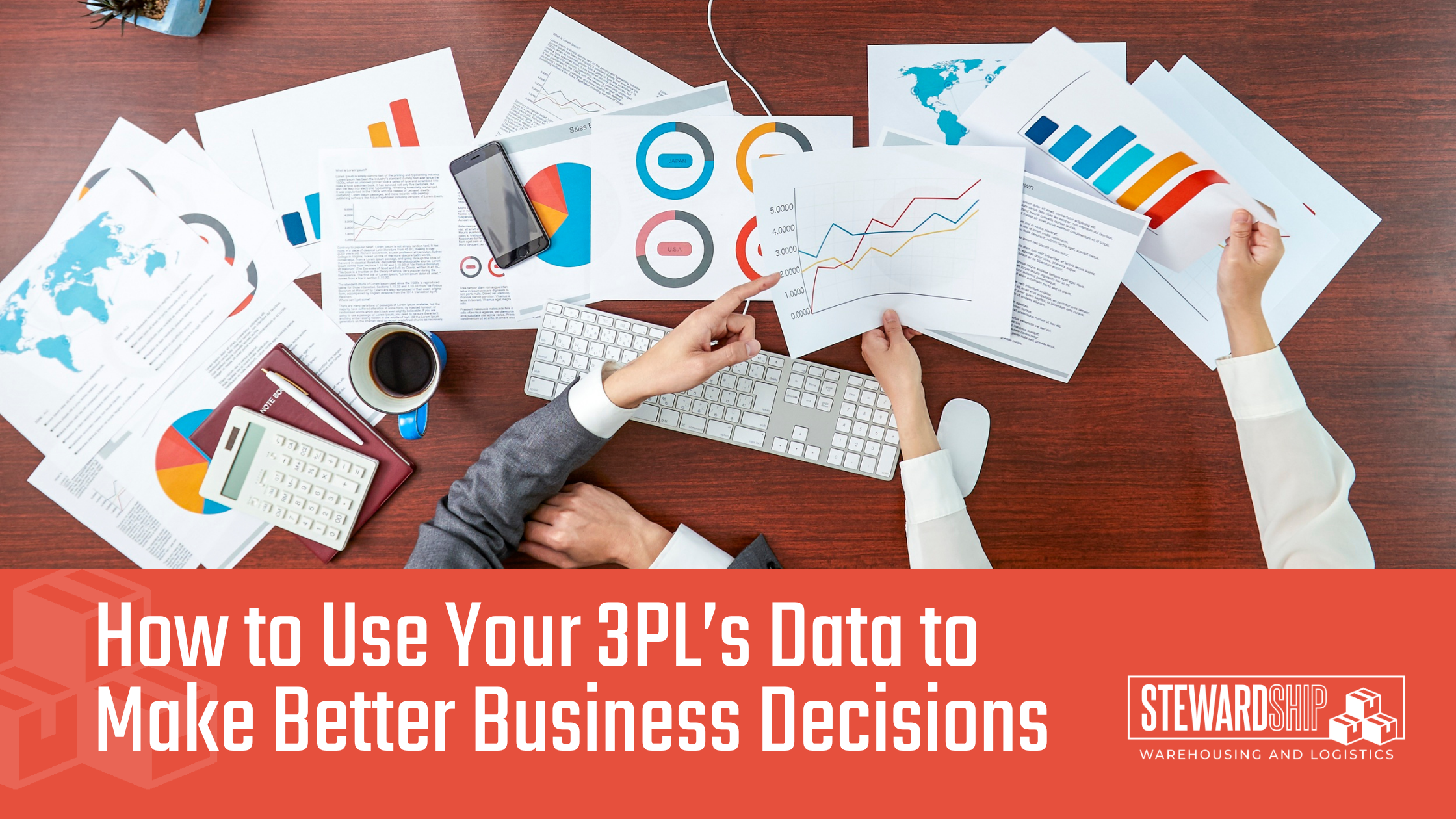
Tracking your company’s growth shouldn’t mean hours in invoices and spreadsheets.
For a lot of businesses, it does. A budget meeting, a pricing review, or a contract renewal comes up, and someone on the team spends days pulling together orders, storage costs, and shipping spend from different places. It’s slow, and the numbers are never as clean as you want them to be.
If you work with a third-party logistics provider (a 3PL, the company that stores your products and ships your orders), part of that work is already done. Your 3PL records your orders, your space, and your shipments every day, and it can pull reports from that information. Most shippers don’t think to ask.
I’ve worked in logistics for a long time, and I run Stewardship Warehousing and Logistics, a 3PL in Northeast Mississippi.
This article covers what data your 3PL can give you, how to use it to see trends and make better business decisions, and what to ask about how they handle your data. It’s for shippers who already work with a 3PL and shippers who are choosing one.
What data can a 3PL give you about your business?
Your 3PL tracks your inventory and orders in a warehouse management system, or WMS. It’s the software that records every pallet that comes in, every order that gets picked, and every package that goes out.
Depending on the 3PL and how your account is set up, that can include:
- Orders processed over time
- How much space you use, and what you’ve paid in rent
- Small parcel shipments by destination
- Inventory movement and the reports built from it
At Stewardship, our WMS produces automated reports, and we can pull history on request. What data you can get depends on your 3PL and its WMS. Later in this article, I share questions to ask about how they handle your data and what reporting you’ll get.
Why does your 3PL’s data matter for business decisions?
Recently, a client who has been with us for five years sent me a request. Their local team was about to meet with their company’s ownership to look ahead to the next three-year contract term. They wanted to show how much their square footage and order volume had grown over the last three years, then map what the next three might look like.
They asked for the rent they’d paid and the number of orders we processed for each of the last two years and this year to date. I pulled the data from our WMS, then used Claude to organize it into the exact format they needed. They walked into that meeting with real numbers instead of estimates.
That kind of history helps with more than a contract renewal. It gives you something solid to work from when you:
- Review your logistics costs each quarter
- Revisit your pricing as the new year approaches
- Plan how much space you’ll need next year
- Decide whether your current warehouse setup still fits your business
Shipping costs are another place the data pays off.
Say you run a business in Tupelo, MS and ship small parcels across the country. You can ask your 3PL to break those shipments down by geography and show where your shipping money goes.
We can run that kind of report from our WMS data to help customers have greater clarity on their costs. Shippers have also asked us what it costs to send a small package from Tupelo to a state like Nebraska on our UPS accounts. It doesn’t come up often, but we can answer it because we have the data.
Rather than pulling this information yourself every time, lean on your 3PL to pull it for you as a starting point for those conversations.
How does AI help you use that data?
Raw data from a WMS can be a lot of information to sift through.
This is where AI tools help. They can read through a large set of records quickly and point out patterns: how your order volume changes through the year, how much of your space you use, and where your orders go. Questions that used to mean a long afternoon in a spreadsheet can take minutes.
AI tools also give better answers when they have more context. If you’re a shipper, the most accurate context about your inventory and orders likely sits with your 3PL, assuming they run a WMS that captures it well.
Context is gold, and your 3PL may be sitting on a lot of it. A good 3PL works like a second brain for your operation. It keeps the records so you can spend your time running the business.
You don’t need to be technical to use any of this. Ask your 3PL for the report you want. If they can’t produce it, that tells you something about the 3PL.
What should you ask a 3PL about how they handle your data?
When you work with a 3PL, you hand over customer names, addresses, and order details. Asking how that information is handled is a fair question, and a good 3PL will answer it.
I’m not going to give you a list of promises to look for. I’d rather give you the questions and let you judge the answers, mine included. They fall into two groups.
How the 3PL handles your data in its own environment:
- Who on your team can see my data, and how do you limit access?
- How do you store and handle my data on your own computers and devices?
- Do you put client data into AI tools? If so, which ones, and what happens to that data?
- What happens to my data when our contract ends?
How the third-party systems handle it, starting with the WMS:
- Which outside systems touch my data? (Your WMS, shipping software, and others)
- Where is your WMS hosted, and who manages it?
- What security information does your WMS provider publish, and can you share it?
- How well do you know your WMS provider? If something goes wrong, how fast do they respond?
Your 3PL’s WMS provider is a good place to look for answers. Check their website for security information or FAQs. Your 3PL’s answers, and how easily they give them, tell you a lot.
What should you ask about reporting before you sign with a 3PL?
If you’re in the process of choosing a 3PL, ask about reporting up front. These questions will show you how much useful information you’ll get later:
- Which reports run automatically, and how often?
- If I ask for historical numbers, how long does it take to get them?
- How do you record my inventory when it arrives? Do you scan it, or manually enter it?
The scanning question matters more than it looks. A warehouse that scans everything has accurate records to report from. A warehouse that manually tracks materials is more likely to include human error in its data.
Ask your 3PL for your numbers
Your 3PL has been recording your business for as long as you’ve worked together.
Whether you’re preparing for an ownership meeting, setting next year’s pricing, or deciding how much space you need, that history can help you decide with more confidence. All you have to do is ask.
And if you’re still choosing a 3PL, ask how they’ll handle your data and what they’ll report back to you before you sign.
At Stewardship, we’re built to answer those questions. Here’s what you get:
- 99% accuracy in shipments and inventory counts
- Real-time inventory management software
- Automated reports from our WMS, plus quick turnaround when you need historical numbers
I believe your 3PL should operate so seamlessly that you don’t even have to think about that part of your business. If you need a 3PL partner in northeast Mississippi to take shipping and fulfillment off your plate so you can focus on other parts of your business, reach out.